

Learning how to start a non profit association begins with more than filing paperwork. A strong nonprofit association needs a clear mission, a committed founding team, proper governing documents, a realistic operating plan, clean financial controls, and a system for managing members, meetings, dues, donations, reports, and communication.
Many people start nonprofit associations because they see a need in their community. They want to support education, health, culture, youth development, professional growth, environmental action, alumni engagement, parent involvement, local welfare, or another public-interest cause. That desire matters. But good intentions alone do not create a sustainable organization.
A nonprofit association must be built carefully. It needs a purpose people understand, rules people can follow, leaders people trust, and records future officers can rely on. If the foundation is weak, the association may struggle with unclear roles, poor finances, missing documents, volunteer burnout, and confusion over who has authority to make decisions.
This guide explains how to start a non profit association in practical steps. It is written for founders, community leaders, school groups, alumni groups, professional networks, cultural organizations, parent associations, and volunteer teams that want to build something useful and lasting.
Important note: this article is general educational content. It is not legal, tax, accounting, or fundraising advice. Nonprofit laws vary by country, state, and organization type. Before filing documents, applying for tax exemption, or collecting funds, speak with a qualified professional or the relevant government office in your jurisdiction.
What Is a Non Profit Association?
A non profit association is an organized group formed to pursue a mission rather than distribute profit to private owners. It may serve members, the public, a community, a profession, a school, a cultural group, or a specific cause.
Nonprofit does not mean the association cannot receive money. A nonprofit association may collect dues, donations, grants, sponsorships, event fees, or service income. The key idea is that surplus funds should support the mission, not be paid out as private profit.
Different countries and states use different legal structures. Some groups may be unincorporated associations. Others may form nonprofit corporations, companies limited by guarantee, charitable organizations, societies, trusts, foundations, or membership associations. The right structure depends on your location, activities, risk, tax goals, fundraising plans, and governance needs.
Step 1: Define the Mission Clearly
The first step is to define the mission. A nonprofit association should be able to explain why it exists in one or two plain sentences.
A weak mission says, “We want to help people.” A stronger mission says, “We support first-generation students in our city with mentoring, school supplies, and career guidance.” The second mission is easier to plan around, fundraise for, and explain to volunteers.
Ask these questions:
- Who do we serve?
- What problem are we trying to solve?
- What activities will we actually carry out?
- Why is a new association needed?
- How will we know we are making progress?
Do not rush this step. The mission will shape your bylaws, programs, fundraising, board recruitment, member communication, and public identity.
Step 2: Research the Need and Existing Organizations
Before starting a new nonprofit association, check whether similar organizations already exist. If they do, consider whether partnership, chapter formation, fiscal sponsorship, or volunteering may be better than creating a new entity.
Starting a nonprofit takes time, administration, and responsibility. If the same need is already served well, duplicating work may divide support. But if there is a real gap, your research will help you explain why your association should exist.
Research should include community conversations, potential member interest, funding possibilities, legal requirements, and practical capacity. A nonprofit should not be built only around enthusiasm. It should be built around a real need and a realistic plan.
Step 3: Choose the Right Legal Structure
The legal structure determines how the association is formed, governed, taxed, and held accountable. In the United States, many nonprofit founders form a nonprofit corporation at the state level, then apply to the IRS for federal tax-exempt status if eligible. In other countries, the structure may be different.
Possible structures may include:
- Unincorporated nonprofit association
- Nonprofit corporation
- Charitable organization
- Company limited by guarantee
- Society or club
- Trust or foundation
- Membership association
The best structure depends on your goals. If you plan to open a bank account, hire staff, sign contracts, apply for grants, own property, or seek tax-exempt status, formal incorporation may be important.
If your organization will have members, dues, votes, meetings, and elected officers, think carefully about membership rights and governance from the start.
Step 4: Form a Founding Board or Steering Committee
A nonprofit association should not depend on one person. Even if one founder had the original idea, the organization needs shared leadership.
A founding board or steering committee helps develop the mission, approve documents, plan registration, set policies, open accounts, and guide the first programs. Choose people who bring useful skills and steady character, not only friends.
Look for people with experience in:
- Community service or the mission area
- Finance and budgeting
- Legal or governance matters
- Fundraising or donor relations
- Administration and recordkeeping
- Communications and outreach
- Program delivery
- Technology or operations
Keep roles clear. Common early roles include president or chair, secretary, treasurer, membership lead, programs lead, and communications lead.

Step 5: Draft Bylaws or a Constitution
Bylaws or a constitution explain how the association will operate. This document should be clear enough for future leaders to follow, not so complicated that nobody reads it.
Bylaws may cover:
- Name and purpose of the association
- Membership categories and rights
- Dues or fees
- Board structure and officer roles
- Election process
- Meeting rules and quorum
- Voting procedures
- Committees
- Conflict-of-interest policy
- Financial controls
- Amendment process
- Dissolution rules
If your structure uses a memorandum and articles, articles of association, or incorporation documents, make sure the documents work together. The Asovex article on definition of memorandum of association explains how founding documents can differ from operating rules.
Step 6: Register the Association
Registration requirements depend on location. In the United States, many nonprofit corporations file articles of incorporation with a state agency. The IRS explains that organizations seeking federal tax-exempt status usually need to be legally organized first and must meet specific organizational and operational requirements.
Registration may involve:
- Choosing and checking the association name
- Preparing formation documents
- Filing with the state or registrar
- Appointing a registered agent, where required
- Paying filing fees
- Receiving a certificate or registration confirmation
- Keeping formation records safely
Before filing, review the official requirements for your state, country, or registrar. A small wording mistake can create delays, especially if you plan to apply for charitable or tax-exempt status later.
Step 7: Get a Tax ID and Open a Bank Account
In the United States, many organizations apply for an Employer Identification Number, or EIN, from the IRS. An EIN is often needed to open a bank account, hire employees, file tax forms, and apply for tax exemption. Other countries have similar tax or registration numbers.
After getting the required identification number, open a bank account in the association’s name. Do not run association money through a founder’s personal account. Mixing personal and association funds creates confusion and risk.
Set financial controls early. Decide who can approve spending, who can sign payments, how receipts are stored, how reimbursements work, and how often financial reports are reviewed.
Step 8: Apply for Tax-Exempt Status if Needed
Not every nonprofit association automatically receives tax-exempt status. In the United States, an organization may need to apply to the IRS for recognition of exemption, such as 501(c)(3), 501(c)(4), 501(c)(6), or another category depending on its purpose and activities.
For example, a charitable education organization may seek 501(c)(3) status, while a business league or trade association may fall under a different category. The IRS has specific rules for each type.
Tax-exempt status is not only a label. It affects fundraising, donations, reporting, restrictions on activities, and public trust. Get professional help if you are unsure which category applies.
Step 9: Build the Membership and Dues Structure
If the nonprofit association will have members, define membership rules clearly. Members should know who can join, what they pay, what benefits they receive, whether they can vote, and how renewal works.
Possible membership categories include:
- Founding members
- Regular members
- Student members
- Corporate or institutional members
- Honorary members
- Supporting members
- Board or committee members
If dues will be collected, document the amount, due date, grace period, late policy, receipt process, and refund policy. The article on are association fees tax deductible explains why clear payment descriptions and receipts matter.
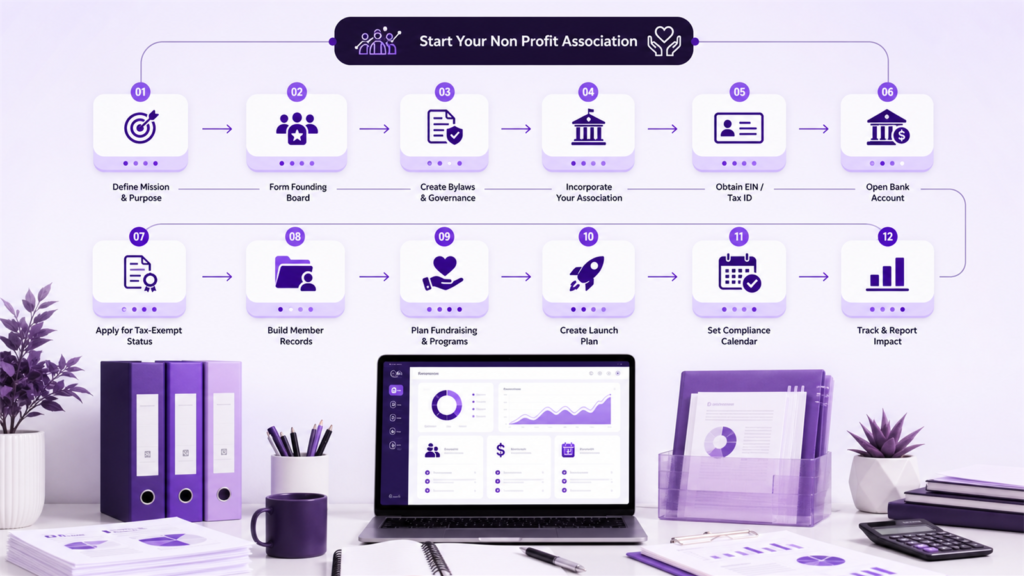
Step 10: Create a Recordkeeping System
Recordkeeping is one of the most overlooked parts of starting a nonprofit association. Founders often focus on the mission and forget the paper trail. But records protect the organization.
Keep these records organized from the beginning:
- Formation documents
- Bylaws or constitution
- Board and member meeting minutes
- Member list and membership categories
- Dues, donations, invoices, and receipts
- Bank records and budgets
- Policies and approvals
- Grant documents and reports
- Volunteer records
- Program records and impact reports
- Annual filings and compliance reminders
If your association starts with scattered files, it will become harder to fix later. The Asovex guide on how to manage association work explains why member records, dues, meetings, documents, voting, reports, and communication should be connected.
Step 11: Plan Your First Programs Carefully
Do not try to launch too many programs at once. Start with one or two activities that match your mission and capacity.
Examples include:
- A community information meeting
- A volunteer day
- A membership launch event
- A mentoring program pilot
- A small scholarship campaign
- A training workshop
- A fundraising dinner
- A public awareness campaign
Each program should have a goal, budget, owner, timeline, volunteer needs, communication plan, and follow-up report. Starting small and doing it well builds trust.
Step 12: Use Digital Tools Early
Many nonprofit associations begin with good people and weak systems. That creates problems when membership grows or leadership changes.
Digital tools can help you manage:
- Members and contacts
- Dues, donations, invoices, and receipts
- Board meetings and minutes
- Documents and policies
- Tasks and follow-ups
- Announcements and newsletters
- Voting and elections
- Reports and dashboards
The Asovex article on what is digital association explains why digital association management is more than having a website. It is about running the core work through connected systems.
Asovex helps nonprofit associations manage members, dues, meetings, documents, communication, roles, reports, and governance workflows in one platform. You can explore Asovex features, see how Asovex works, or compare pricing plans.
Common Mistakes to Avoid
The first mistake is starting without a clear mission. If the mission is vague, programs and fundraising will be scattered.
The second mistake is building around one person. A nonprofit association needs shared leadership and documented roles.
The third mistake is ignoring legal structure. The right structure affects liability, tax treatment, grants, bank accounts, and governance.
The fourth mistake is weak financial controls. Association money should never be mixed with personal money.
The fifth mistake is poor records. Missing minutes, receipts, member lists, and policies can damage trust.
The sixth mistake is trying to do too much immediately. Start with a few well-managed programs.
The seventh mistake is delaying digital systems until chaos appears. It is easier to start organized than to clean up later.
Nonprofit Association Startup Checklist
- Define the mission and beneficiaries.
- Research the need and similar organizations.
- Choose the right legal structure.
- Form a founding board or steering committee.
- Draft bylaws, constitution, or operating rules.
- Register the organization where required.
- Apply for a tax ID or equivalent number.
- Open an association bank account.
- Apply for tax-exempt status if needed.
- Create membership and dues rules.
- Set financial controls and receipt processes.
- Build a document and recordkeeping system.
- Plan one or two first programs.
- Use digital tools for members, meetings, dues, documents, and reports.
If your founding team needs help managing deadlines and follow-up, the Asovex post on software for task tracking explains how teams can assign owners, deadlines, documents, and recurring action items.
Final Thoughts
Starting a nonprofit association is a meaningful step, but it should be done with care. A strong association needs a clear mission, committed leaders, proper documents, financial discipline, organized records, and a practical plan for serving members or the public.
The goal is not only to register an organization. The goal is to build something that can survive leadership changes, earn trust, manage money responsibly, communicate clearly, and deliver real value.
Asovex helps associations create that operational foundation by managing members, dues, receipts, meetings, documents, reports, communication, roles, and governance workflows. Visit Asovex, explore the features, or read more guides on the Asovex blog.
Frequently Asked Questions
How do I start a non profit association?
Start by defining the mission, researching the need, forming a founding board, choosing a legal structure, drafting bylaws, registering the organization, setting financial controls, building member records, and creating a clear operating plan.
Do I need to register a nonprofit association?
It depends on your location, activities, fundraising plans, and legal structure. Many organizations register formally if they want a bank account, tax-exempt status, grants, contracts, or liability protection.
Can a nonprofit association collect dues?
Yes. Many nonprofit associations collect member dues, donations, event fees, or sponsorships. The funds should support the mission and be recorded clearly.
What documents does a nonprofit association need?
Common documents include bylaws or constitution, formation documents, meeting minutes, member records, financial policies, conflict-of-interest policy, bank records, receipts, and annual reports.
Is a nonprofit association automatically tax exempt?
No. In many jurisdictions, nonprofit formation and tax-exempt status are separate. In the United States, organizations usually need to apply to the IRS for recognition of federal tax exemption if they want that status.
Can Asovex help manage a nonprofit association?
Yes. Asovex can help nonprofit associations manage members, dues, donations, receipts, meetings, documents, reports, communication, roles, voting, and governance workflows.