

Time management methods and techniques matter because most people do not run out of work. They run out of clear time, clear priorities, and clear follow-through. This is especially true for association leaders, administrators, volunteers, treasurers, secretaries, committee chairs, and small teams who are trying to manage members, meetings, dues, documents, reports, events, and communication at the same time.
Time management is not about squeezing more tasks into an already crowded day. That usually leads to rushed work, missed details, tired leaders, and meetings that produce more meetings. Real time management is about deciding what deserves attention, protecting space for important work, reducing avoidable interruptions, and building a rhythm that your team can actually keep.
For associations, this is not a small issue. Poor time management affects member experience. Dues reminders go out late. Meeting minutes are delayed. Reports are rushed. Documents are misplaced. Volunteers burn out. Members start wondering if the association is organized enough to serve them well.
The good news is that time management can be learned. You do not need a perfect personality, a complicated app, or a silent office. You need a few practical methods, used consistently. This guide explains the best time management methods and techniques for people who handle real operational work, especially in associations and membership-based organizations.
What Is Time Management?
Time management is the practice of planning and controlling how time is used so important work gets done with less stress and less waste. It includes choosing priorities, scheduling focused work, limiting distractions, managing meetings, delegating tasks, reviewing progress, and saying no when a task does not belong in the current season.
At its best, time management is not a rigid timetable. Life is not that obedient. A member will call with an urgent issue. A payment record may need checking. A meeting may run long. A document may be missing. Time management gives you a way to recover when the day bends, instead of letting one interruption destroy the whole week.
For association work, time management also has a shared side. It is not only about one leader being productive. It is about helping the whole organization know what is due, who owns it, where records live, and when decisions need to happen. That is why digital systems, clear roles, and organized workflows are so important. If you have not read it yet, the Asovex guide on how to manage association work explains how members, dues, meetings, documents, and reports fit together.
Why Time Management Fails for Many Teams
Most time management problems are not caused by laziness. They are caused by unclear systems.
A team may be busy all day but still miss the important work. A secretary may spend hours replying to messages but still not finish the minutes. A treasurer may work late but still not reconcile dues records. A committee chair may attend every meeting but still fail to move a project forward.
Here are common reasons time management fails:
- Everything feels urgent, so nothing is truly prioritized.
- Tasks are stored in private chats, memory, notebooks, or scattered documents.
- Meetings are scheduled without clear decisions or follow-up.
- People accept new tasks without checking capacity.
- Work is not assigned to a specific owner.
- Administrative tasks are repeated manually every week.
- There is no weekly review to catch delayed work early.
The solution is not to work harder. The solution is to make work easier to see, easier to schedule, and easier to complete.
1. The Priority Method: Decide What Matters First
The first time management technique is priority setting. It sounds obvious, but it is often skipped. Many people start the day with whatever is loudest: the newest message, the nearest deadline, the person asking most urgently, or the task that feels easiest.
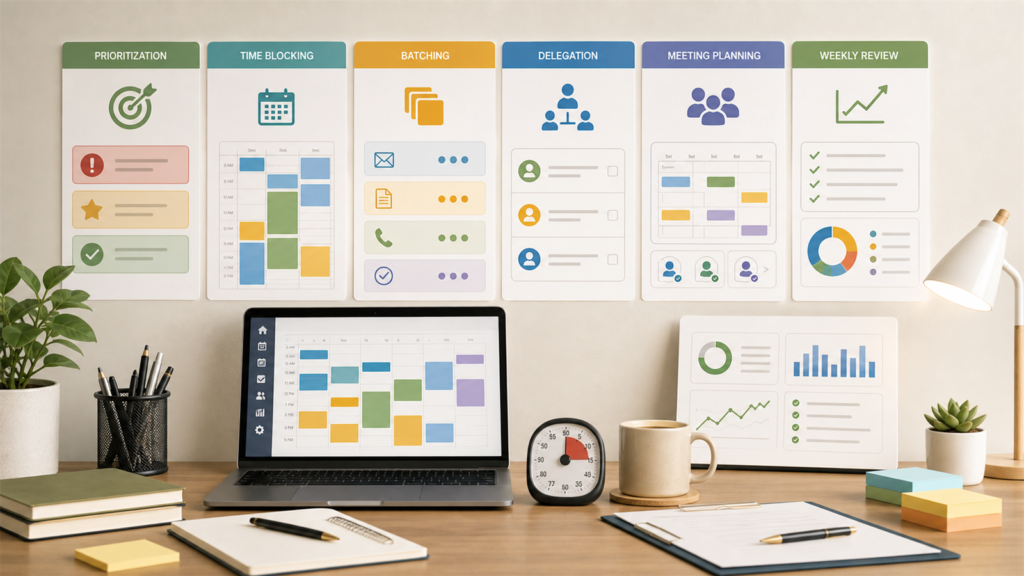
A better method is to separate tasks into three groups:
- Must do: tasks that protect trust, money, compliance, deadlines, or member experience.
- Should do: tasks that matter, but can move if something more important appears.
- Could do: useful tasks that should not steal time from higher-value work.
For an association, “must do” may include sending dues receipts, preparing board meeting documents, publishing AGM notices, responding to payment issues, or filing required reports. “Should do” may include improving templates, cleaning old folders, or updating an event page. “Could do” may include nice design tweaks or low-priority admin cleanup.
This method keeps leaders honest. If everything is labeled urgent, the word urgent stops meaning anything.
2. The Eisenhower Matrix: Separate Urgent From Important
The Eisenhower Matrix is one of the most useful time management methods and techniques because it helps you see the difference between urgency and importance. It divides work into four categories:
- Urgent and important: do it soon.
- Important but not urgent: schedule it.
- Urgent but not important: delegate it or handle it quickly.
- Not urgent and not important: remove it or postpone it.
Many associations live in the urgent-and-important box because they neglect the important-but-not-urgent work. For example, cleaning member data is not urgent until election eligibility becomes confusing. Updating dues rules is not urgent until members dispute invoices. Organizing documents is not urgent until a new officer cannot find the policy they need.
The best leaders protect time for important work before it becomes an emergency. That is where real calm begins.
3. Time Blocking: Give Important Work a Place on the Calendar
Time blocking means reserving specific blocks of time for specific types of work. Instead of keeping a long task list and hoping the day makes room, you assign work to the calendar.
For example:
- Monday morning: review dues and finance records.
- Tuesday afternoon: prepare meeting agenda and documents.
- Wednesday morning: member communication and follow-up.
- Thursday afternoon: reports and planning.
- Friday morning: weekly review and next-week preparation.
Time blocking works because it reduces decision fatigue. You are not asking “what should I do now?” every hour. The calendar gives direction.
Do not block every minute. Leave buffer time. Association work often includes human interruptions, and humans rarely arrive in tidy fifteen-minute boxes. A realistic calendar beats an impressive one that collapses by lunch.
4. Task Batching: Group Similar Work Together
Task batching means doing similar tasks in one focused block instead of switching between unrelated tasks all day. This is especially helpful for administrative work.
For example, instead of checking dues payments, writing one email, opening a meeting document, answering a chat, checking another payment, and then returning to the meeting document, batch the work:
- Process all dues receipts in one block.
- Reply to member emails in two planned windows.
- Prepare meeting documents together.
- Approve pending member updates at a set time.
- Review reports once, then share summaries.
Switching between tasks burns attention. Batching protects it. It also helps teams because people learn when certain work is handled. Members may not need instant replies if they know finance requests are processed every morning and receipts are sent before the end of the day.
5. The Two-Minute Rule: Clear Small Tasks Carefully
The two-minute rule says that if a task truly takes less than two minutes, do it immediately. This can be useful for tiny tasks: confirming a meeting time, forwarding a receipt, saving a document in the right folder, or replying with a short answer.
But use this technique carefully. Many tasks pretend to be two-minute tasks and then quietly take twenty minutes. “Let me quickly check that report” can become a long detour. “Let me just reply to this message” can turn into a full discussion.
The rule works best for small, closed tasks. If a task needs thought, research, approval, or multiple steps, put it in the task system instead of letting it steal your focus.
6. The 80/20 Rule: Find the Work That Produces the Most Value
The 80/20 rule, also called the Pareto Principle, suggests that a small portion of work often creates a large portion of results. In association management, this can be very true.
A few processes may create most member satisfaction: fast receipts, clear meeting notices, useful events, reliable reports, and responsive communication. A few problems may create most complaints: late dues updates, missing documents, unclear roles, confusing membership status, or poor meeting follow-up.
Use this technique by asking:
- Which tasks create the most value for members?
- Which problems create the most repeated stress?
- Which processes, if fixed, would save the most time every month?
- Which reports help leaders make better decisions?
Do more of the work that matters. Simplify or remove the work that mostly creates motion without progress.
7. Weekly Review: Keep the System Honest
A weekly review is one of the easiest techniques to ignore and one of the most powerful to keep. It is a short meeting with yourself or your team to check what happened, what is pending, what is blocked, and what needs attention next.
A good weekly review asks:
- What did we complete this week?
- What is overdue?
- What needs a decision?
- What must be prepared for next week?
- Which members, payments, meetings, or reports need follow-up?
- What can we remove, delay, or delegate?
This review stops small delays from becoming big emergencies. It also gives leaders a habit of looking ahead, not only reacting to today.
8. Meeting Discipline: Make Meetings Earn Their Time
Meetings can be useful, but they can also become the biggest leak in the calendar. A meeting should exist because discussion or decision is needed. It should not exist only because the calendar repeats it.
Before scheduling a meeting, ask:
- What decision or outcome do we need?
- Who must be there?
- What should people read before attending?
- Can this be handled with a short update instead?
- What will happen after the meeting?
For association leaders, meeting discipline is essential. Board meetings, committee meetings, finance reviews, and member meetings should have agendas, time limits, assigned action items, and stored minutes. If your association is becoming more digital, the Asovex post on what is digital association explains how connected systems can improve meetings, documents, communication, and member access.
9. Delegation: Stop Treating Every Task as Personal
Many leaders struggle with time management because they carry too much alone. Sometimes they do this because they care. Sometimes because they do not want to bother others. Sometimes because explaining the task feels slower than doing it.
But if one person owns everything, the association becomes fragile. Delegation is not dumping work. It is giving the right task to the right person with clear expectations.
Good delegation includes:
- The task to be done
- The expected result
- The deadline
- The files or context needed
- The level of authority
- The check-in point
For example, “Please handle event follow-up” is vague. “Please send the attendance list and thank-you message to all registered members by Friday afternoon, then update the event folder with the final attendee count” is much clearer.
10. The One-Owner Rule: Every Task Needs a Name
A task without an owner is a wish. In meetings, people often say “we should update the member list” or “someone should send reminders.” That sounds like progress, but nobody may actually do it.
Use the one-owner rule. Every task gets one owner, even if several people help. The owner is responsible for moving it forward or reporting what is blocking it.
This technique is simple but powerful. It reduces confusion, prevents duplicate work, and makes follow-up easier. It also protects relationships because missed work is easier to discuss when expectations were clear from the beginning.
11. Use Templates for Repeated Work
If you write the same message, report, agenda, or reminder more than twice, create a template. Templates save time and reduce mistakes.
Associations can use templates for:
- Meeting agendas
- Meeting minutes
- Dues reminders
- Payment receipts
- New member welcome messages
- Event invitations
- Monthly treasurer reports
- Committee updates
- Election notices
Templates should not make communication feel lifeless. They simply give structure. You can still write warmly inside a clear format.
12. Build a Single Source of Truth
Time disappears quickly when people cannot find information. A member list in one place, dues records in another, minutes in a private inbox, documents in someone’s laptop, and updates in a chat group create hidden time costs.
A single source of truth means your team knows where official information lives. Member records live in the member system. Dues records live in the finance system. Meeting minutes live in the document system. Tasks live in the task tracker. Reports come from reliable data.
This is one reason Asovex focuses on connected association management. When member data, dues, meetings, documents, communication, roles, and reports work together, leaders spend less time searching and more time serving members. You can review the broader platform on the Asovex features page.

13. Protect Deep Work Time
Deep work is focused time for tasks that need real thought. For association leaders, this may include reviewing financial reports, preparing a board pack, writing a strategy document, cleaning membership data, drafting a policy, or planning an annual meeting.
Deep work is hard when messages, calls, and small tasks interrupt constantly. Protecting it may mean turning off notifications for one hour, closing email, setting office hours, or telling the team when you are unavailable for quick questions.
You do not need four silent hours. Even one protected hour can change the quality of your work.
14. Use Deadlines Before the Real Deadline
A dangerous habit is treating the official deadline as the working deadline. If the annual report is due Friday, finishing it Friday morning leaves no space for review, errors, missing documents, or approval.
Create internal deadlines before external deadlines. If a board pack must go out on Thursday, finish the draft by Tuesday. If dues notices must be sent on the first day of the month, review the dues list three days earlier. If minutes need approval, prepare them while the meeting is still fresh.
This technique creates breathing room. It also makes your association feel more professional because fewer things are rushed at the last moment.
15. Say No With a Reason, Not an Apology
Time management also means protecting capacity. Associations often attract generous people, and generous people can overcommit. But saying yes to everything eventually reduces the quality of everything.
A good no is respectful and clear:
“We cannot add that project this month because dues renewal and the AGM are the priority. Let us review it in the next planning meeting.”
That kind of answer protects the work without dismissing the idea. It shows that time is being managed, not ignored.
16. Automate Repetitive Administrative Tasks
Automation is not about removing people. It is about reducing repetitive manual work so people can focus on judgment, service, and leadership.
Associations can often automate or systemize:
- Dues reminders
- Receipt generation
- Meeting notifications
- Member status updates
- Document storage workflows
- Report exports
- Role-based access
- Renewal notices
The more recurring work you automate, the more time your leaders regain. This is especially important for volunteer-led associations where administrative energy is limited.
17. Match the Method to the Person
Not every method works for everyone. Some people love detailed calendars. Others prefer short daily lists. Some need visual boards. Others need reminders. A good team does not force everyone into one personality style, but it does agree on shared visibility.
For example, a treasurer may work best with scheduled finance blocks. A secretary may need meeting templates and document checklists. A president may need a weekly dashboard. Committee leaders may need action boards and deadlines.
The best time management system is the one your team will actually use.
A Simple Weekly Time Management Routine
If you want a practical routine, start here:
- Monday: choose the top three outcomes for the week.
- Tuesday: handle focused project or reporting work.
- Wednesday: process member communication and admin tasks.
- Thursday: prepare meetings, documents, and decisions.
- Friday: review completed work, overdue tasks, and next week’s priorities.
You can adjust the days, but keep the rhythm. Prioritize, focus, communicate, prepare, review.
Time Management Checklist for Association Leaders
- Write down every open task in one place.
- Mark each task as must do, should do, or could do.
- Give every task one owner.
- Block time for finance, meetings, communication, and reports.
- Batch similar tasks instead of switching all day.
- Use templates for repeated messages and documents.
- Set internal deadlines before official deadlines.
- Hold a weekly review.
- Reduce unnecessary meetings.
- Store official records in one reliable place.
- Automate reminders, receipts, and reports where possible.
- Review what is wasting time and fix one process at a time.
Final Thoughts
Time management methods and techniques are not magic tricks. They are simple habits that protect attention, reduce confusion, and help important work happen on time. The real power comes from using them consistently.
For association leaders, time management is more than personal productivity. It affects trust, money, meetings, records, member experience, and leadership health. A well-managed calendar can mean faster dues follow-up, better meeting preparation, clearer communication, stronger reports, and less burnout.
Start small. Choose one method this week: time blocking, task batching, weekly review, meeting discipline, or the one-owner rule. Use it long enough to feel the difference. Then add another.
And when your association is ready for a better operating system behind the work, Asovex helps bring members, dues, meetings, documents, reports, communication, roles, and governance into one connected platform. Visit Asovex, explore the features, see how it works, or read more practical guides on the Asovex blog.
Frequently Asked Questions
What are the best time management methods and techniques?
The best time management methods and techniques include priority setting, the Eisenhower Matrix, time blocking, task batching, the two-minute rule, the 80/20 rule, weekly review, delegation, meeting discipline, templates, and automation.
How can association leaders manage time better?
Association leaders can manage time better by setting weekly priorities, assigning one owner to every task, batching admin work, reducing unnecessary meetings, using templates, keeping records in one place, and reviewing overdue work every week.
What is the simplest time management technique to start with?
The simplest technique is to choose the top three outcomes for the week and block time for them on the calendar. This creates focus before smaller tasks take over the day.
How does time blocking work?
Time blocking works by reserving specific blocks of time for specific types of work. For example, an association treasurer might block Monday morning for dues review and Friday morning for reports.
Why do meetings waste so much time?
Meetings waste time when they have no clear agenda, no required decision, too many attendees, weak preparation, or no follow-up. A good meeting should end with decisions, owners, deadlines, and stored notes.
Can software improve time management?
Yes. Software can improve time management by centralizing records, automating reminders, organizing tasks, tracking dues, storing documents, and making reports easier to prepare. The key is to use tools that match the team’s workflow.