Create or receive
Bring a document into the association workspace with enough information to understand what it is and why it matters.

A focused workspace for member management, meetings, finances, communication, and governance.
Get StartedAsovex helps associations organize files around the members, meetings, projects, financial activity, decisions, and responsibilities they support—so records remain useful beyond one inbox or officer term.
A folder can tell you where a file was placed. It does not always explain whether the file is current, who approved it, which meeting or member it concerns, who should see it, or what future officers need to know.
When documents live across email attachments, personal drives, messaging apps, paper folders, and individual devices, teams waste time searching and risk acting from incomplete or outdated information.
Asovex keeps documents closer to their operational meaning, helping the association retain both the file and the context required to use it responsibly.
Locate records through recognizable association work, not only an exact filename.
Understand the member, meeting, decision, project, or responsibility behind a document.
Keep access and maintenance aligned with the people trusted to manage the record.
Document management becomes dependable when people understand what should happen before, during, and after a file is actively used.
Bring a document into the association workspace with enough information to understand what it is and why it matters.
Relate the record to the meeting, member, project, committee, decision, or responsibility that gives it context.
Make the document available to the people whose roles require it without treating every record as public to everyone.
Keep working material current, make approved changes deliberately, and reduce uncertainty about which file should guide the work.
Preserve the final record and useful history according to the association’s own operational and governance responsibilities.
Association documents have different audiences. A public member resource, committee draft, payment record, leadership report, and confidential administrative file should not automatically be treated the same way.
A useful process distinguishes preparation, review, approval, and retained history without creating needless complexity.
Create or collect the content required for discussion and development.
Give the responsible people a clear opportunity to assess and revise it.
Identify the version or outcome the association has formally accepted.
Preserve final material and relevant context for future reference and continuity.
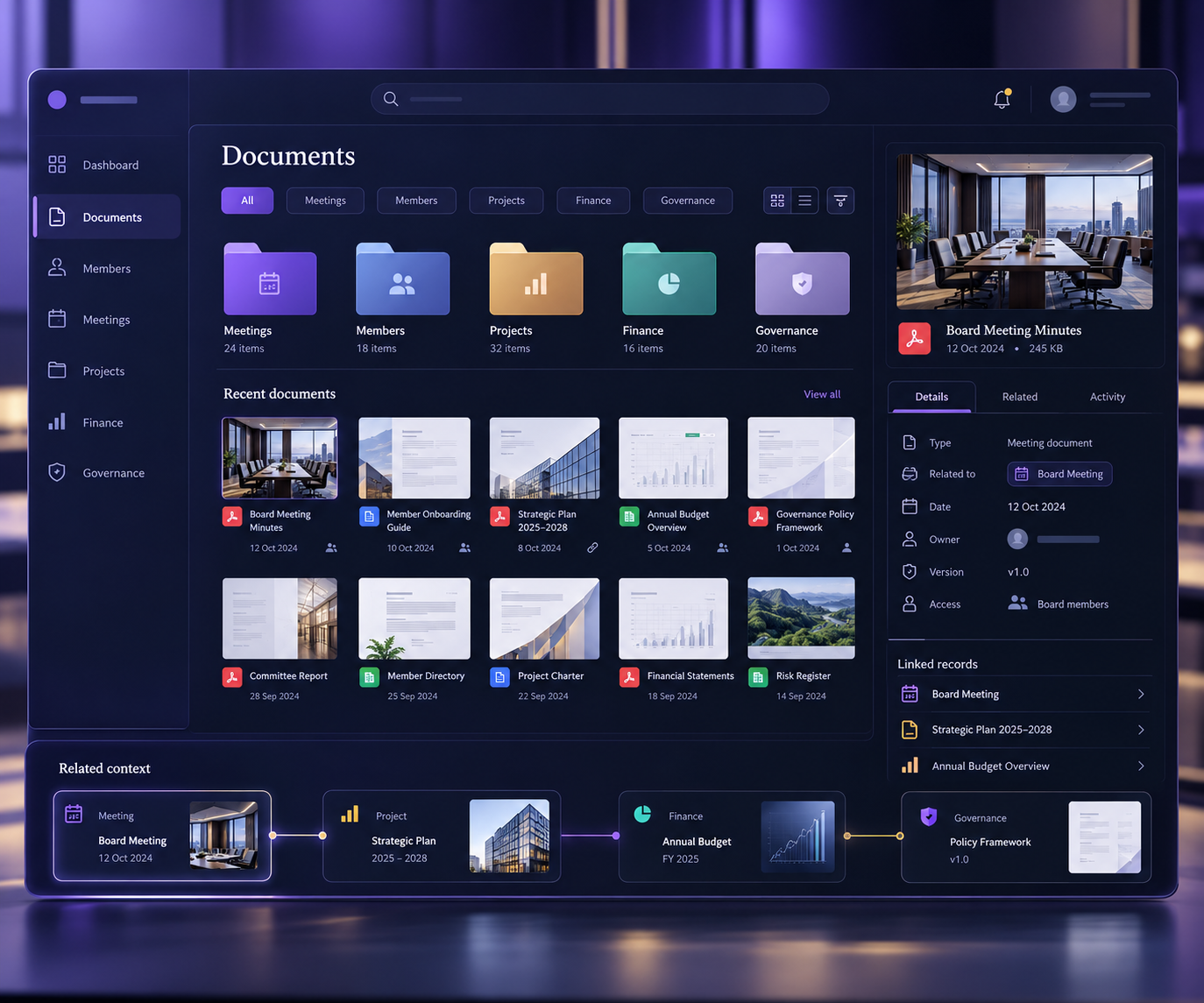
A document is easier to understand when people can see the association activity around it. Asovex supports a connected environment instead of forcing teams to maintain separate file silos.
Different records require different treatment, but they should still be understandable within one association environment.
Agendas, attendance context, minutes, resolutions, action references, and supporting material.
Forms, correspondence, status records, member-linked documents, and authorized administrative evidence.
Receipts, payment evidence, approved reports, budgets, expense support, and other financial records.
Policies, constitutions, election records, officer material, committee reports, and approved decisions.
Briefs, working files, deliverables, review notes, reports, and the evidence behind association initiatives.
Notices, approved publications, member resources, templates, and material used for consistent updates.
Transitions are easier when incoming leaders inherit an understandable record base rather than a collection of unexplained attachments. Keep essential knowledge with the association as people and responsibilities change.
Bring current documents and important historical records out of fragmented personal storage.
Keep enough information around each record for the next responsible person to understand how it should be used.
Give new officers a clearer starting point for decisions, recurring work, and unfinished responsibilities.
Fast retrieval is valuable, but trustworthy retrieval also depends on naming, context, ownership, and a clear relationship to current association activity.
Use meaningful titles and operational context so people are not forced to remember an exact filename created by someone else.
Understand whether a record belongs to a meeting, member, project, financial process, committee, or governance responsibility.
Give authorized users enough context to recognize whether the document is working material, approved information, or retained history.
Space matters, but association document management also depends on findability, appropriate access, usable context, continuity, and a workflow people can maintain.
See how Asovex worksDocuments should not become a dead-end library. Move from the record into the people, decisions, deliverables, and responsibilities that make it useful.
Understand how connected document management supports everyday administration, responsible access, and long-term continuity.
Association document management software gives a member-led organization a structured place to organize files and records, control appropriate access, connect documents to operational context, and preserve useful information beyond one officer or committee term.
Cloud storage can hold files. Association document management also considers why a record exists, which meeting, member, project, financial activity, or governance responsibility it supports, who should access it, and how future officers will understand it.
Yes. Asovex is designed around connected association operations, allowing documents to remain closer to the meetings, projects, members, leadership responsibilities, and other work that gives them meaning.
Asovex supports role-based access so document visibility can align with legitimate association responsibilities. Each organization remains responsible for deciding its roles, policies, and appropriate access arrangements.
A shared and organized record base reduces dependence on personal devices, email attachments, and individual memory. Incoming officers can begin with clearer files, context, decisions, and operational history.
Yes. Small associations can start by organizing the records that matter most. Asovex offers a Free plan for associations with up to 10 members, with additional plan options as requirements develop.
Start with the records your team uses most, connect them to the work they support, and build a document practice the association can carry forward.