

Association Management Software vs Spreadsheets: Which Is Better?
Most associations do not begin by shopping for a large system. They begin with what is available: a spreadsheet of members, a folder of documents, a group chat, and a few people who know where the important information lives. For a small, stable organization, that approach can be entirely reasonable.
The question is not whether spreadsheets are good or bad. The more useful question is: when does an association need something more connected? Comparing association management software vs spreadsheets helps leaders decide whether their current tools still match the work they need to do.
This guide offers a fair comparison. Spreadsheets remain useful for many tasks. Dedicated association software becomes valuable when member records, dues, meetings, documents, roles, communication, and reporting need to work together rather than remain in separate files.
Association Management Software vs Spreadsheets: The Core Difference
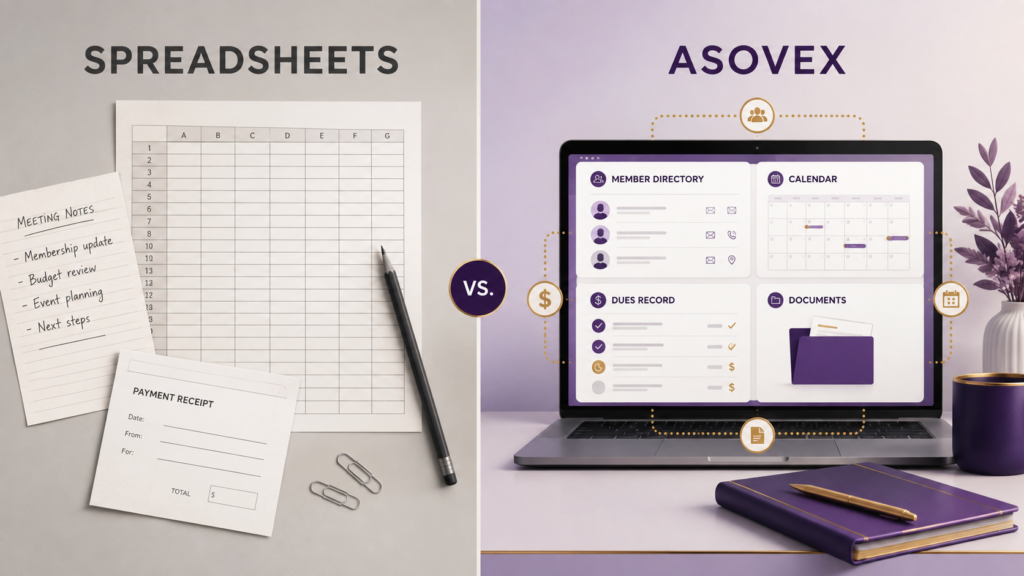
A spreadsheet is a flexible table. It can hold names, dates, amounts, categories, and calculations, and it can be adapted to many purposes. Association management software is a purpose-built operational environment that connects records and workflows around the way a membership organization runs.
That difference matters because associations rarely manage just one list. They manage members and statuses, officer roles, dues or contributions, meetings and attendance, minutes, documents, notices, and governance records. A spreadsheet can record parts of that work, but it does not naturally preserve the relationship between each area.
Software is not automatically the better answer for every association. It is a stronger fit when the organization needs shared access, clearer permissions, connected records, and a more dependable way to hand responsibilities from one officer to another.
When Spreadsheets Work Well
Spreadsheets are useful because they are familiar and adaptable. They can be a practical choice when a group has a small member list, a simple dues arrangement, limited operational activity, and one or two people responsible for keeping the records current.
Simple member lists
A straightforward list of names, contact details, and a few membership notes can often be managed well in a spreadsheet. It is quick to create, easy to review, and suitable for a group whose information changes infrequently.
One-off planning and analysis
Budgets, event estimates, committee planning, and temporary calculations are all good spreadsheet use cases. Even associations using a dedicated platform may continue using spreadsheets for special analysis or presentations.
Limited shared responsibilities
If the same person maintains the records and there are few handovers or permissions to manage, a spreadsheet may be sufficient for the moment. The key is to recognize when this simplicity starts to create hidden dependence on one person’s files or memory.
Where Spreadsheets Start to Create Friction
The challenge is not that a spreadsheet cannot store information. It is that the association may need several spreadsheets, folders, messages, and manual checks to understand one member’s full context. As activity grows, the effort of keeping those sources aligned can become more noticeable.
Member records become disconnected
A member may appear in one directory, have a payment note in another file, register for a meeting through a form, and communicate through an unrelated chat. Each record can be accurate on its own while the overall picture remains difficult to review.
Access becomes harder to manage
Sharing a spreadsheet may expose more information than every recipient needs. Creating separate copies can solve one access problem while introducing another: people may be working from different versions of the same record.
Meeting and governance records live elsewhere
Agendas, minutes, attendance sheets, election records, and supporting documents are often stored separately from the member list. When an officer needs historical context, finding it can mean searching multiple locations.
Manual follow-up becomes repetitive
Dues reminders, status changes, document requests, and meeting notices can require repeated manual communication. The association may still handle this well, but leaders should be honest about how much routine coordination is taking place outside the main record.
9 Practical Differences to Consider
1. Connected member information
Spreadsheets usually require manual cross-referencing between tabs or files. Association software can keep member profiles, statuses, responsibilities, and related activity in a more connected environment.
2. Dues and payment context
A spreadsheet can log an amount and date. A dedicated dues workflow can keep payment activity closer to the member record, with payment status, contribution records, and supporting evidence where applicable. For more detail, see Asovex’s association dues management software overview.
3. Meetings, attendance, and minutes
A spreadsheet can list attendees, but association operations often need schedules, RSVP information, attendance records, minutes, and related documents to remain available over time. A shared workspace can give these records a clearer home.
4. Roles and permissions
In a spreadsheet, access is often broad: someone can see the file or cannot. Association software can support role-based access so administrators, treasurers, secretaries, leaders, and members work with the areas relevant to their responsibilities.
5. Communication context
Email and chat remain useful, but they do not automatically preserve the association context around a notice or activity. Announcements and notifications connected to the workspace can make important communication easier to locate later.
6. Documents and continuity
Shared folders improve document access, but an association still needs a consistent way to organize official records through leadership changes. Central document management can make important materials easier for authorized people to find.
7. Reporting visibility
Spreadsheets can produce reports when someone builds and maintains them. Association software can provide a more organized foundation for operational and financial reporting based on the records leaders are already maintaining.
8. Handover between officers
A well-kept spreadsheet can be handed over, but the process may still depend on explaining formulas, file locations, and informal conventions. A shared operational system can preserve more of that context alongside the records themselves.
9. Growth without rebuilding the process
As members, meetings, committees, and records increase, a spreadsheet structure may need frequent redesign. A purpose-built system can provide a more stable operational foundation while the association’s needs develop.
What an Association Management System Adds
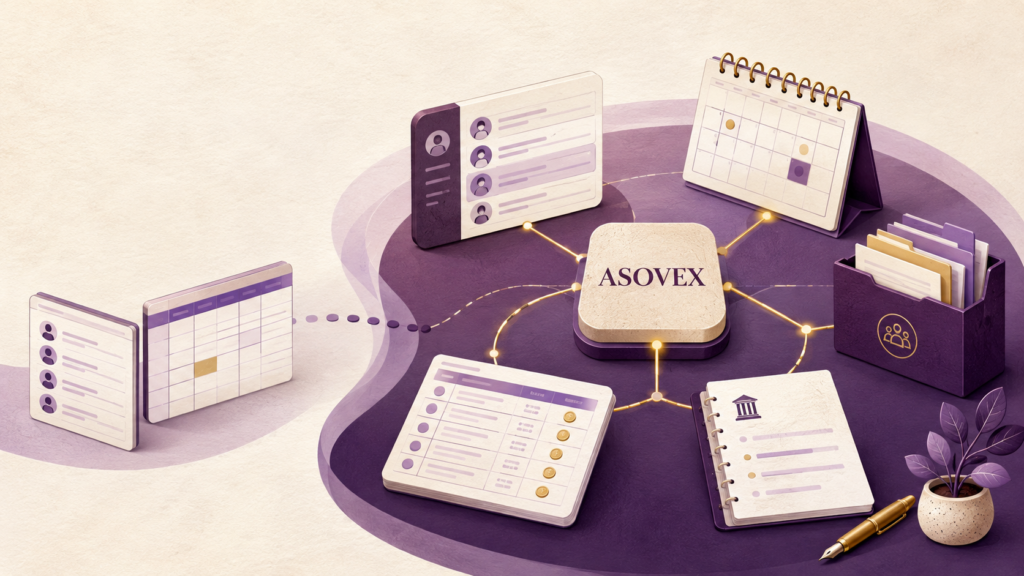
An association management system is not simply a more elaborate spreadsheet. It is a way to bring the association’s core operational areas into one environment. That can include member management, dues and contribution records, meetings, attendance, minutes, documents, communication, leadership roles, role-based access, elections, voting, and reporting.
Asovex is designed around those connected association workflows. Its association management software page explains the platform’s broader approach to membership operations, finance, meetings, governance, documents, and communication.
For a category-level explanation before comparing specific tools, read What Is Association Management Software?. It explains what an AMS is designed to organize and why the connection between records matters.
When Should an Association Move Beyond a Spreadsheet?
There is no universal trigger. The decision usually becomes clearer when leaders begin spending too much time reconciling information rather than using it. A move may be worth considering when several officers need reliable access, when membership and payment records must remain connected, when meeting and governance records are growing, or when a handover feels risky.
Other signals include duplicate versions of the same file, uncertainty about which record is current, difficulty finding past decisions, or a dues process that requires repeated manual checks. These are not failures. They are signs that the association’s operating model may have become more complex than its original tools.
A Fair Approach for Small Associations
Small associations do not need to adopt complexity simply because larger organizations use specialized systems. The right starting point is the level of organization the group needs today, together with the ability to manage future responsibilities without starting over.
Asovex offers a Free plan at $0 for associations with up to 10 members. It can give a small group a structured place to evaluate association-management workflows without beginning with a software subscription. The free association management software guide offers a practical perspective on choosing a no-cost option, while current plan details are available on the pricing page.
How to Evaluate Your Current Setup
Before switching tools, map the records your association already manages. List where member information lives, who owns dues administration, where meeting documents and minutes are stored, how leaders communicate, and what needs to be available during an officer handover.
Then identify the points where people must manually connect information. If a treasurer has to match one file to another, a secretary has to search personal emails for minutes, or an administrator has to ask several people for a member’s status, those are useful starting points for improvement.
You do not need to change every process at once. Many associations begin by centralizing the member directory, then introduce a clearer dues workflow, meeting records, documents, or role-based access as the need becomes more immediate. The How It Works page provides an overview of the Asovex workspace.
Frequently Asked Questions
Is association management software better than a spreadsheet?
It depends on the association. Spreadsheets can work well for simple lists and one-off analysis. Association software becomes more useful when records need to be connected across members, dues, meetings, documents, roles, and shared administration.
Can a spreadsheet track association members?
Yes. A spreadsheet can be a practical way to track a basic member list. The limitation is that member information may become disconnected from other association records as operations become more complex.
Can association software help with dues management?
Yes. Association software can support member-linked dues and contribution records, payment status, payment proof workflows where applicable, and organized financial reporting. Read our guide on managing membership dues efficiently for the operational process.
What is the biggest risk of using multiple spreadsheets?
The main risk is not the spreadsheet itself. It is maintaining several versions of related information across different files, people, and devices, which can make current records and handovers harder to manage.
Can small associations use Asovex?
Yes. Asovex has a Free plan at $0 for associations with up to 10 members. Review the pricing page for current plan information.
Choose the Tool That Matches the Work
Association management software vs spreadsheets is not a contest with one correct answer for every group. Spreadsheets remain useful for simple records and focused analysis. A connected association platform becomes valuable when leaders need shared visibility, durable records, appropriate access, and workflows that extend beyond a single list.
Start with the responsibilities that currently create the most manual effort. Then explore how Asovex can support organized association operations as your records, members, and leadership responsibilities develop.
For association-sector learning and professional development, ASAE is a useful external resource for people who work with associations and membership organizations.